
Earthrise: the Earth rising over the lunar horizon, photographed by Bill Anders on Apollo 8 (AS08-14-2383)

The Apollo missions

Apollo VII–XVII follows every crewed Apollo mission, from the first test flight in Earth orbit in 1968 to the last landing in 1972. Each mission page below has the dates, the crew and restored photographs from the book.

Apollo 7

11–22 October 1968. Apollo 7 was the first crewed flight of the Apollo program.
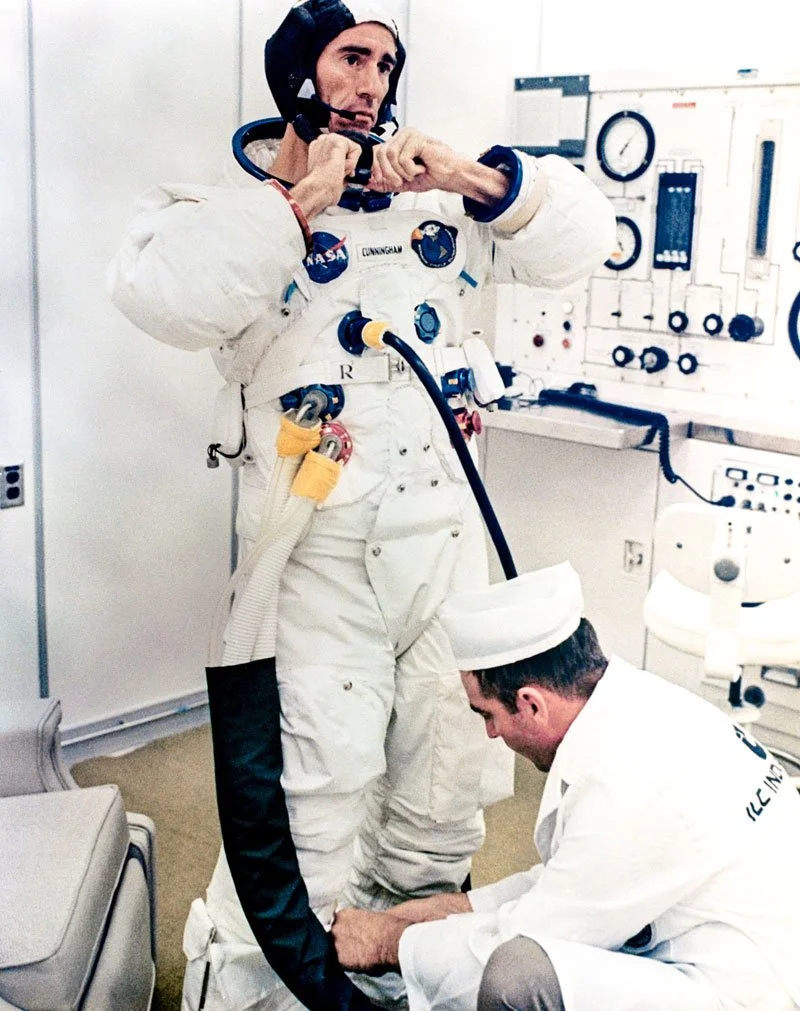
Walter Cunningham being suited up before the Apollo 7 mission

Apollo 8

21–27 December 1968. Apollo 8 was the first crewed flight to the Moon.

Earthrise (AS08-14-2383). Taken by Bill Anders on 24 December 1968 with a 250 mm telephoto lens, through the spacecraft window during lunar orbit
Earthrise (AS08-14-2383). Taken by Bill Anders on 24 December 1968 with a 250 mm telephoto lens, through the spacecraft window during lunar orbit.

Apollo 9

3–13 March 1969. Apollo 9 was the first crewed flight of the Lunar Module.

David Scott standing in the open hatch of the Command Module Gumdrop above the Earth
David Scott standing in the open hatch of the Command Module Gumdrop above the Earth (AS09-20-3064).

Apollo 10

18–26 May 1969. Apollo 10 was the full dress rehearsal for the first Moon landing.
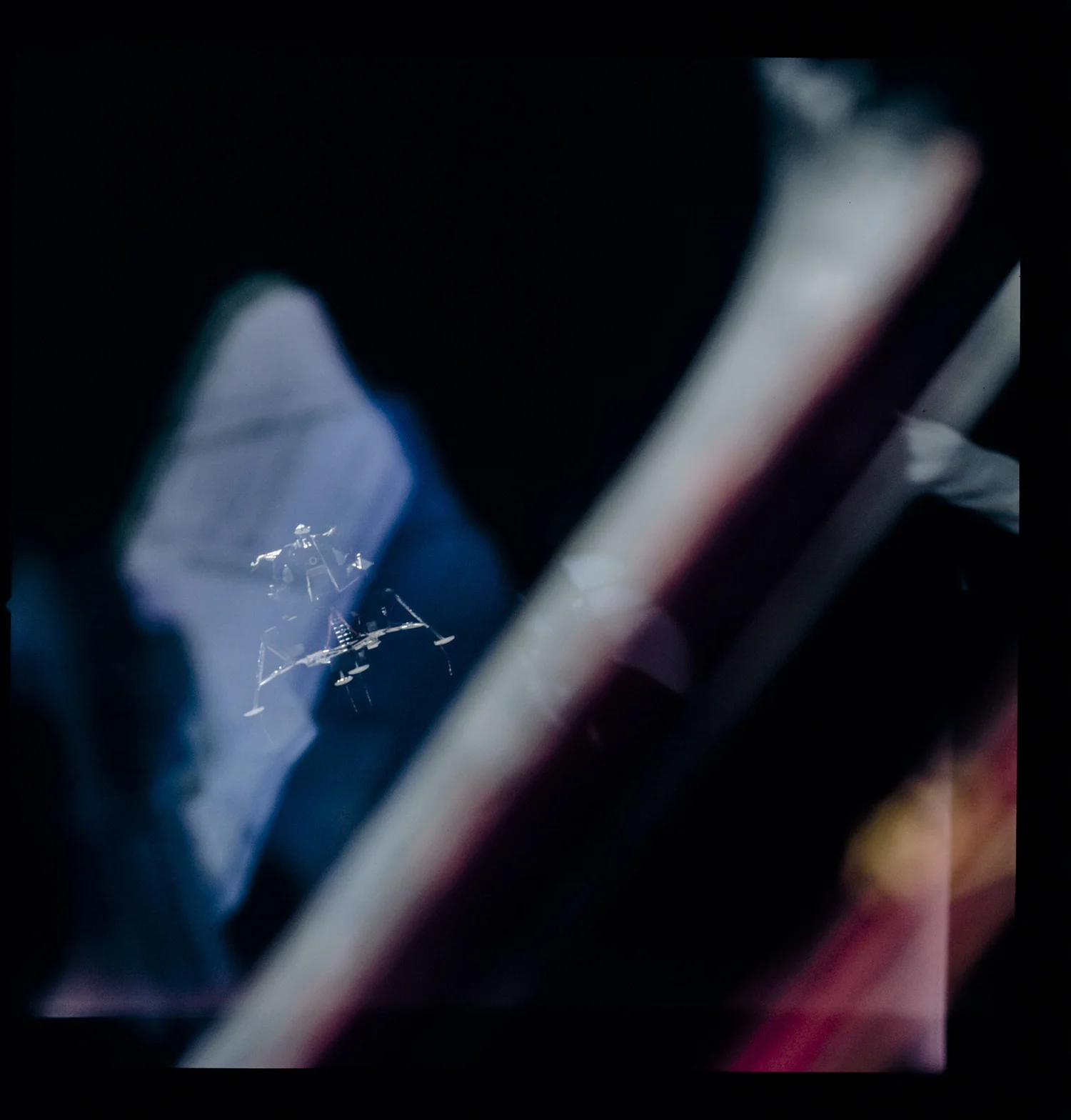
The Lunar Module seen through the window of the Command Module in lunar orbit
The Lunar Module seen through the window of the Command Module in lunar orbit (AS10-34-5082).

Apollo 11

16–24 July 1969. Apollo 11 was the first crewed landing on the Moon.

Buzz Aldrin on the Moon, with the Lunar Module Eagle and Neil Armstrong reflected in his gold visor (AS11-40-5903). Taken by Armstrong with the Hasselblad lunar surface camera and its 60 mm lens
Buzz Aldrin on the Moon, with the Lunar Module Eagle and Neil Armstrong reflected in his gold visor (AS11-40-5903). Taken by Armstrong with the Hasselblad lunar surface camera and its 60 mm lens.

Apollo 12

14–24 November 1969. Apollo 12 was the second crewed landing on the Moon.

Pete Conrad reflected in Alan Bean’s visor while Bean holds a sample container
Pete Conrad reflected in Alan Bean’s visor while Bean holds a sample container (AS12-49-7278).

Apollo 13

11–17 April 1970. Apollo 13 was planned as the third crewed landing on the Moon, in the hilly Fra Mauro formation.

The “mailbox” inside the Lunar Module Aquarius: the improvised adapter that let the crew use the Command Module’s square lithium hydroxide canisters to remove carbon dioxide from the cabin
The “mailbox” inside the Lunar Module Aquarius: the improvised adapter that let the crew use the Command Module’s square lithium hydroxide canisters to remove carbon dioxide from the cabin (AS13-62-8929).

Apollo 14

31 January – 9 February 1971. Apollo 14 was the third crewed landing on the Moon and the first after the Apollo 13 accident.

Apollo 15

26 July – 7 August 1971. Apollo 15 was the fourth crewed landing on the Moon and the first of three longer missions that NASA called J missions.

Apollo 16

16–27 April 1972. Apollo 16 was the fifth crewed landing on the Moon and the second of the longer J missions.

John Young leaping and saluting the flag during the first moonwalk at Descartes, photographed by Charlie Duke (AS16-113-18339). The Lunar Module Orion and the Rover are in frame
John Young leaping and saluting the flag during the first moonwalk at Descartes, photographed by Charlie Duke (AS16-113-18339). The Lunar Module Orion and the Rover are in frame.

Apollo 17

7–19 December 1972. Apollo 17 was the sixth and last crewed landing of the Apollo program.

The Blue Marble (AS17-148-22727), taken on 7 December 1972 a few hours after launch, from roughly 29,000 km (18,000 miles) away. Africa, the Arabian Peninsula and Antarctica are clearly lit
The Blue Marble (AS17-148-22727), taken on 7 December 1972 a few hours after launch, from roughly 29,000 km (18,000 miles) away. Africa, the Arabian Peninsula and Antarctica are clearly lit.

Apollo 7 to Apollo 17, 1968–1972